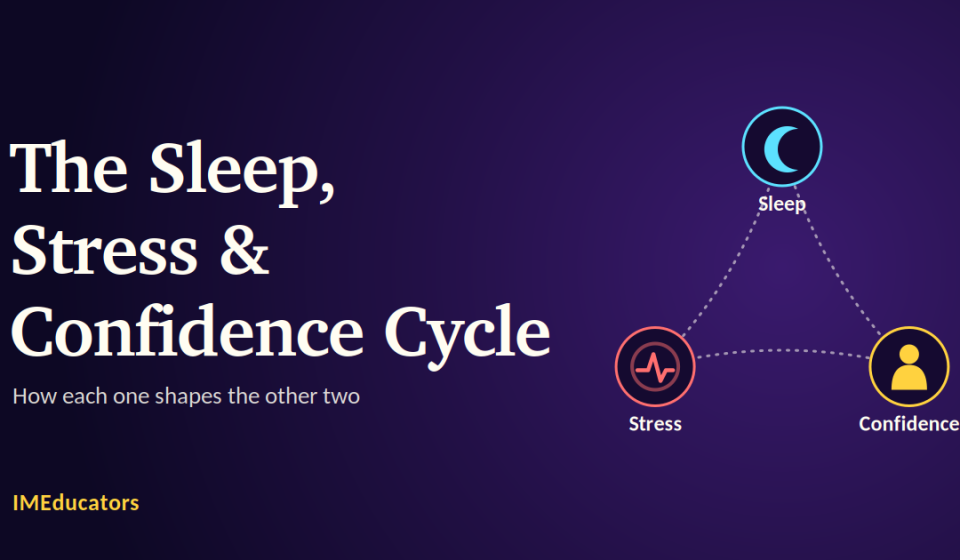

Stress, poor sleep, and shaky confidence rarely show up alone. Have a bad night, and you’re more on edge the next day. Feel anxious walking into a meeting, and your mind races too much to sleep that night. Each one feeds the others, which is good news once you see it the right way: working on any one of them tends to help the other two as well.
Here’s how the three connect, and where to start if you’re dealing with more than one at once.
Stress keeps your body on alert
Stress is your body’s response to a perceived threat, and it’s meant to be temporary. Your heart rate rises, your muscles tense, and your mind narrows its focus onto the problem in front of you. That’s useful for a genuine emergency. It’s less useful when the “threat” is a full inbox or a difficult conversation you’re dreading, and it’s actively harmful when it doesn’t switch off once the moment has passed. Chronic, low-grade stress keeps your nervous system running in a state that was only ever meant to be brief.
Why stress makes sleep harder
Falling asleep requires your body to downshift out of that alert state, and a stressed mind resists doing that. Racing thoughts, a tense body, and a mind still replaying the day are some of the most common reasons people lie awake long after they’ve turned out the light. It’s not that stressed people need less sleep. It’s that stress makes the transition into sleep harder to complete, even when the time and opportunity to rest are both there.
Why poor sleep undermines confidence
Confidence isn’t just a mindset, it’s also a byproduct of how well-resourced you feel. Sleep loss affects mood regulation and makes you more reactive to setbacks, so a rough night often shows up the next day as second-guessing yourself, feeling less articulate, or reading too much into a small stumble. It’s hard to walk into a room feeling sure of yourself when your body is running on too little rest. Confidence takes a hit not because anything about you has changed, but because your capacity to handle the moment calmly has been temporarily reduced.
And a confidence dip feeds new stress
The cycle closes here. When you feel less sure of yourself, ordinary situations start to feel more threatening: a presentation, a difficult conversation, a room full of new people. That reads as more stress, which makes the next night’s sleep harder, and the pattern repeats. None of this means anything is wrong with you. It means these three systems are wired together, so a dip in one shows up as a dip in the others.
Where to start
You don’t have to fix all three at once, and trying to usually backfires. Pick the one that feels most within reach right now.
- If sleep is the sticking point, start with a consistent wind-down routine and a fixed wake time, even on weekends. A racing mind at bedtime often responds well to a relaxation-based approach, including guided hypnosis, which is designed specifically to help the body let go of the day and ease into sleep.
- If stress feels like the root of it, a daily practice that actively downshifts your nervous system, rather than just distracting from the stress, tends to help more than willpower alone. This is where a structured stress-relief program can do more than generic advice to “relax.”
- If confidence is what’s slipping, small, repeated wins matter more than a single pep talk. Confidence-building work that gives you a specific, practiced response for the moments that rattle you tends to hold up better than trying to simply think more positively.
Whichever you start with, expect some spillover into the other two. Better sleep tends to lower next-day stress. Lower stress tends to make sleep come more easily. And steadier confidence makes the whole cycle less likely to start in the first place.
If you’d like structured support with any part of this cycle, our sleep program, stress program, and confidence program each walk you through a guided approach built around one piece of it. Most people find that working on one starts to ease the others too.